Why I only write when I feel like it

“Write every day” is common advice pounded into aspiring writers’ heads. If not every day, writers are encouraged to schedule writing time and stick to weekly routines. The purpose is to train your creative brain to produce a steady stream of writing regardless of inspiration.

I love routines. My perfect morning starts with making my bed, a chai latte, and breakfast for my poodles followed by twenty minutes of reading and a leisurely shower. I love how routines minimize decision making and ensure I focus on my priorities.

However, a routine is a luxury not everyone can sustain. My body is unreliable. My health changes from hour to hour without warning. It does not abide by any clock or calendar, no matter how hard I try to bribe it. As a disabled and chronically ill person, I have given up on routines.

When I first got sick, I thought if I followed a strict routine, I would feel better. I created a conservative schedule of medications, healthy meals, exercise, and sleep. I tried to follow it every day and every day I failed. My routine was destroyed by bouts of dizziness, midday vomiting, and nighttime muscle spasms. Instead of feeling better, I felt worse as I clung to my schedule and ignored my body’s demands.

Five minutes of writing a day may seem like an easy commitment (I have tried it!), but some days I can barely walk or shower. Some days I must choose between eating and resting. Some days brain fog robs me of my words. On a bad day, I don’t need the added disappointment and guilt of a writing routine I can’t maintain.

I am not less of a writer, because I can’t write every day. In fact, my experience with chronic illness and disability enriches my writing. Furthermore, I love writing and doing what I love, at my own pace, is healing. In the end, writing when I feel like it helps me feel like writing much more often.

4 tips for writers with chronic illness (and everyone else)

1.  Set realistic, meaningful goals
I have less energy than most people, so I must choose my goals carefully. A near death experience incited my desire to launch blog. I cannot blog every day or every week, but I strive to post every two weeks. I remind myself that the quality of my posts matters more to me than the quantity. I also decided not to monetize my blog in order to save my energy for writing.

2. Write when you feel good, wherever that may be
Inspiration is extremely elusive when you feel like crap most of the time, so I make every effort to capture it. I’ve trained myself to jot every idea into my phone no matter what I’m doing. I dictated half of this blog post into my phone while sitting in traffic. Notes and outlines help me write when I feel good, but I’m not inspired. I always bring these with me to my medical appointments, where I spend a lot of time waiting.

3. Enjoy less taxing, creative activities when you don’t feel good
I’ve learned how to enjoy myself when my brain feels like mush. Podcasts, books, movies, and coloring are low-energy activities that can be great distractions, while stimulating creativity. You totally have my permission to binge on Netflix. I also recommend networking with other writers on social media. Networking can be as simple as liking someone’s posts and sending goofy memes. The chronic illness and disabled writing communities are awesome.

4. Be kind to yourself
Your body is not the enemy. When I’m unable to meet my goals due to my health, I acknowledge that I’ve been busy trying to stay alive. There is no writing pace that guarantees success, but you do need be alive in order to write. Fighting your own body and criticizing your limitations is not productive. Self-care will make you a better writer.

What goes up must come down

When I was seven years old, I took my first plane ride to California. I was technically visiting my aunt, but we all know I was really there for Disneyland. My parents promised me the Happiest Place on Earth and I believed them.

My aunt had the honor of taking me. Holding my hand, she led me around the theme park, as I marveled at the attractions. The first item we bought was an autograph book, commencing the hunt for Disney characters. As the morning progressed, I became braver at approaching princesses. I even procured my own princess hat.

So, when my aunt suggested Splash Mountain, I was excited. I love water. She asked me if I was sure, and I said yes. To be certain, we watched several boats drop down the waterfall, as the photo kiosk captured gleeful riders.

I hopped into the seat next to my aunt and boat continued to glide forward through the towering rock walls. I grasped my aunt’s hand on one side and the handrail on the other. The first dip, a few feet, made me giggle and my hands relaxed. We drifted along the outside of mountain, and re-entered the dark cavern, this time surrounded by ducks, alligators, and bears. At each turn, new creatures sang and danced along to the catchy big band music vibrating throughout the mountain.

I snapped back to vigilance as we approached the first big conveyor belt. The boat tipped backward and I tried to determine how high we were climbing, but it was dark. I simultaneously wanted the rumbling of the boat to stop and to not stop. Finally, a small circle of daylight appeared at the top of the lift.

My aunt squeezed my hand and whispered in my ear, “What goes up must come down.”

I tried to pull my hand away. My aunt snickered. I tried to reckon with her warning. I imagined throwing a ball in the air. The ball fell. I didn’t want to fall. I was only seven years old, but I knew gravity always won. Why would my aunt do this to me?

My panic was interrupted by the sight of the tree line. I’m pretty sure I wasn’t touching the boat as we dropped down side of the mountain. The boat began to climb another conveyor belt and my aunt taunted, “What goes up must come down.”

“I don’t want to go up anymore!” I screamed.

*****

My mast cells are beating up my right kidney again. The pain got so bad I swore I’d never drink water again, but I need water to live, so I decided to try a prednisone burst instead.

I FEEL GREAT!

If you’ve never been on high doses of prednisone, it’s sort of like 3 shots of espresso, except the buzz lasts from 8 am to 4 am every day. In fact, I forgot to drink coffee this morning, as if coffee is optional. I was too distracted by overwhelming feelings of hope, determination, and joy. I spent the morning scanning documents, mending clothes, and vacuuming air ducts. I’ve eviscerated every miscellaneous pile lurking in my condo.

From there, I moved on to shopping, online AND in stores. My FitBit battery can barely keep up. I take breaks for eating, of course. Food tastes great and prednisone allows me to digest many MCAS forbidden foods like spaghetti and chocolate. It’s impossible to cook a meal without dancing.

I’ve got my ducks in a row. I’ve got my poodles in a row. I am the best version of myself.

Of course, I wish I could feel this way every day, but prednisone is black magic. The main side effect is total destruction of your body. It eats your muscles and bones, while you swell into a bulbous blob. After a few months, your can-do attitude is offset by atrophy and disfigurement. My body is still recovering from 2015, when I took high dose prednisone for a full year.

I know what’s coming. I have already begun to taper my high dose. In a few days, my heart will pound, my head will swirl, and I will struggle to sit up on the couch. I will want to sleep from 8 am to 4 am every day. I will tell my friends I feel like I am dying.

What goes up must come down, but I’m sure as hell going to enjoy this ride while it lasts.

Note: I was unfortunately diagnosed with secondary adrenal insufficiency in 2022. I am grateful that I was able to take prednisone when I needed it to prevent damage to my body, but it was incredibly hard to regain normal cortisol levels after I went into remission.

I did a thing

Do you ever get a strong urge to go somewhere or do something totally out of the ordinary? There’s no apparent explanation for it, but you MUST do the thing.

As soon as the snow melted, I NEEDED to go canoeing. I NEEDED to leave the city and paddle down a river lined with tall, green trees.

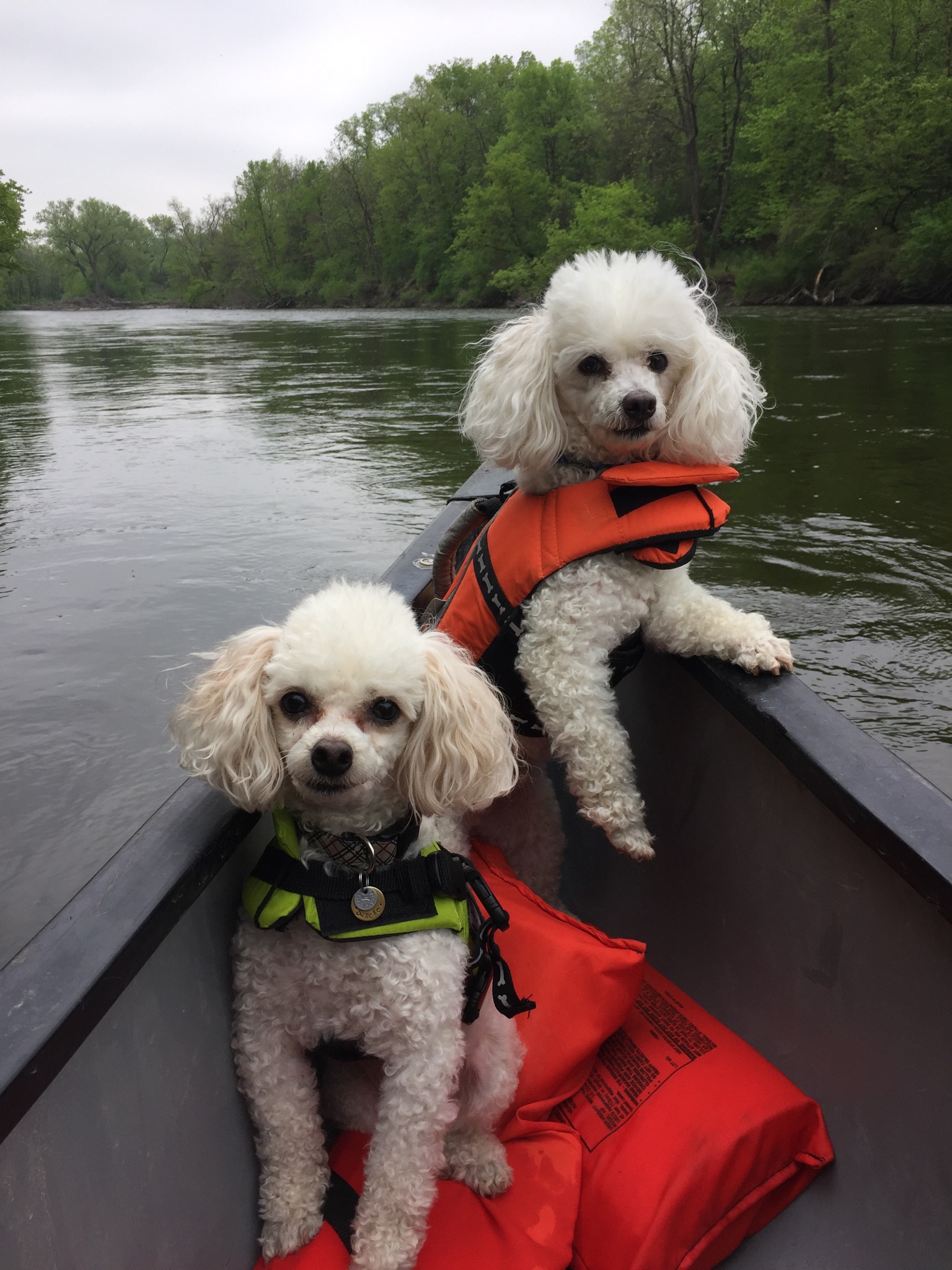
Maybe it was an instinctual calling after months of hibernation and mountains of snow? Or maybe it was my body craving a physical challenge as it slowly regained strength? Maybe it was just an excuse to put my dogs in their adorable life vests?

This urge contradicted every precaution I’ve taken every day for the past three years. I imagined how many ways canoeing could go wrong:

  • The sun could trigger anaphylaxis and I would need an emergency airlift. The helicopter pilot would find me by following the trail of vomit floating down the river.
  • My arms could dislocate or lose all muscle strength. I would lose control of canoe and end up floating into the Mississippi River. Maybe the Gulf of Mexico.
  • A bee or a swarm of mosquitos could attack me and trigger anaphylaxis. Another river of vomit; another airlift.
  • I might fall in, have trouble breathing, and depend on my two toy poodles to swim me to shore. Except they are toy poodles, so obviously we’d end up in the Gulf of Mexico.
  • Everything could go well, but I might lose all energy right before I needed to drive back to the city. I have no idea how much that Uber would cost.

I did not feel confident.

The urge continued to nag, “You really need to update your Facebook photos. Think of how cute your poodles will look!”

So, I texted a friend, “Do you want to go canoeing?”

I waited for her to tell me it’s a horrible idea.

“Sure,” she said, because I have supportive friends that let me test my horrible ideas.

So, I picked a 4-foot-deep river and a cloudy day.

Perched on the bow, I felt a bit more confident, like an explorer, brandishing my paddle. I only dropped it once. The river, aside from a few mild rapids, gently guided us down stream. Basically, we floated the whole two hours. Our only real job was not to make any sudden movements and tip the boat.

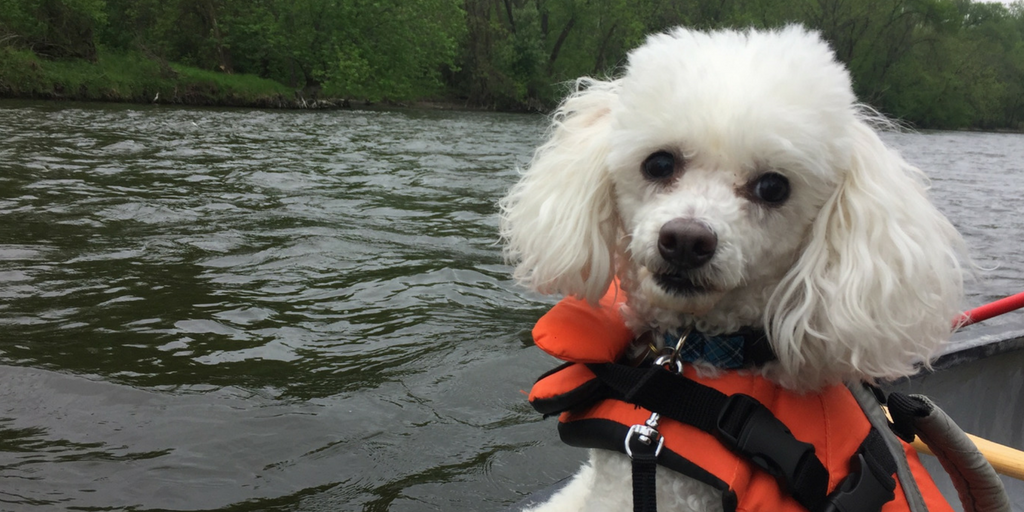
My only source of anxiety during the trip was when one of my poodles tried to fight a bald eagle. Quixote, who is 9 pounds and cowers at geese, had no reservations about barking and lunging at a bald eagle swooping increasingly closer to our boat. I imagine the eagle was ultimately dissuaded by his blaze orange life vest, completely validating the hour I spent digging the vest out of storage.

When we reached the landing, I leaped out of the boat and dragged it onto the shore declaring my victory. I was alive. I did the thing. My friend congratulated me on an uneventful voyage, but only I could truly appreciate what I had achieved. I knew my accomplishment could be attributed to luck (the weather was absolutely perfect) as much as determination (months of painful rehabilitation). But most importantly, it was about conquering fear.

And my Facebook photos got so many likes.

IMG_9247